

Center for Business and Public Policy Announces New Research Appointments

Posted in Announcements News
The Center for Business and Public Policy at Georgetown University’s McDonough School of Business is pleased to welcome four new scholars to its research team. Their collective expertise across industrial organization, technology policy, digital platforms, energy regulation, and public finance advances the center’s mission to deliver rigorous, empirical economic analysis at the nexus of business and public policy.
Shir Bloch, Research Fellow
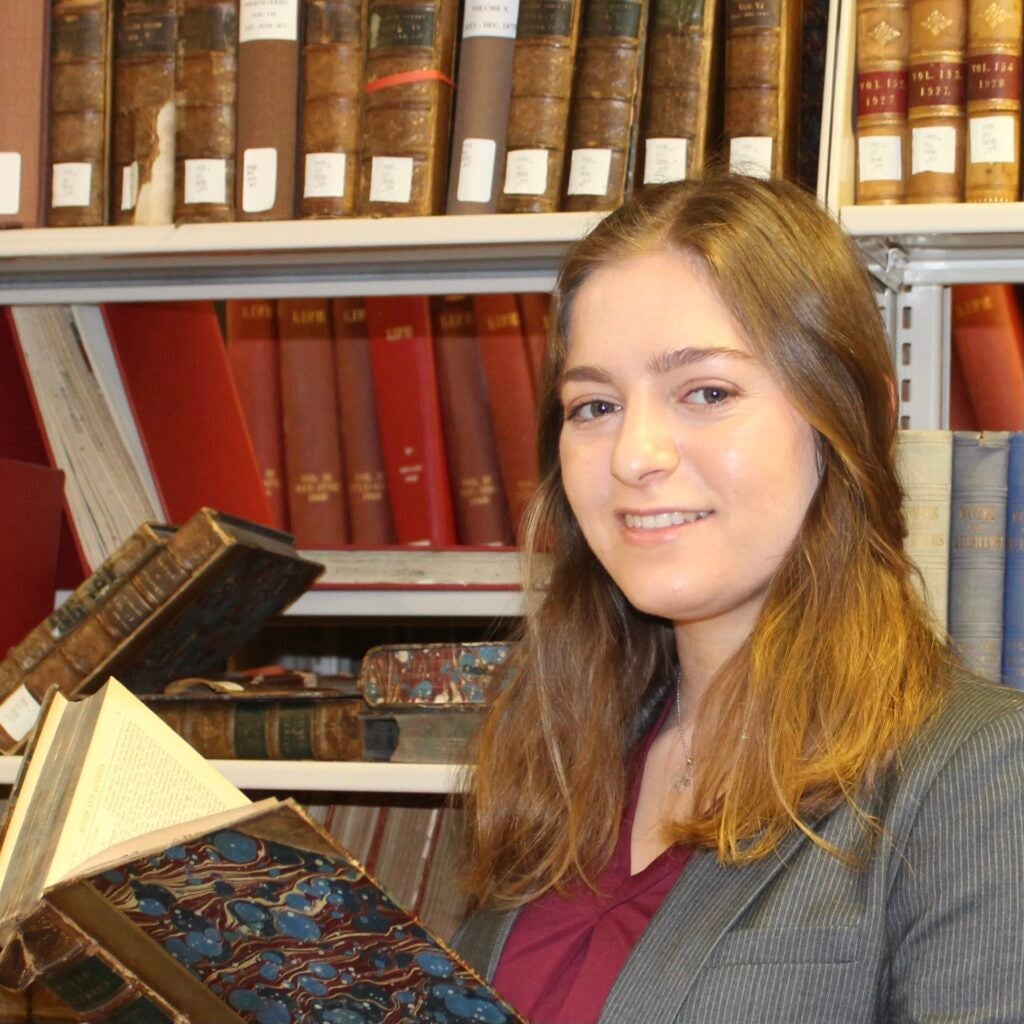
Shir Bloch is a fourth year Ph.D. candidate in the Economics Department at Georgetown University. In her dissertation, she studies tax credits for electric vehicle charging stations, the spillover effects of government R&D funding post-Sputnik, and the tradeoff between fair representation and efficient allocation of public funds in electoral settings.
This multifaceted research portfolio is in line with Bloch’s long fascination with democratic institutions and public policy, which she has explored through interdisciplinary training. In college, she majored in philosophy, political science, and applied mathematical economics, allowing her to marry the critical thinking and communication skills of the humanist traditions with the rigorous econometric approaches of the social sciences.
As a policy intern at Nelson Mullins Riley & Scarborough, Bloch managed the appropriations process for fiscal year 2023 and provided federal grant application guidance for the firm’s pro-bono clients and for Congressional staff. Bloch was also a founding advisory board member of the Civic Dialogues program at Marquette University, her alma mater, which created spaces for students to engage in open and honest dialogue about timely sociopolitical issues in an attempt to escape the echo chambers of social media. In her free time, Bloch enjoys reading and baking.
Zhentao Jiang, Postdoctoral Research Fellow

Zhentao Jiang received her Ph.D. in economics from Georgetown University. Her research focuses on industrial organization, and she is also interested in labor economics and applied microeconomics with a focus on digital platforms.
Jiang’s recent work studies the New York City ride-hailing market, asking how minimum wage regulation for drivers ripples through to the platforms that dispatch them and the riders who use them. She is also working on the economics of movie theaters and how queuing systems treat groups differently from individuals.
Outside of research, Jiang is an amateur panda researcher — a field she insists demands extensive fieldwork at zoos.
Michael Karas, Postdoctoral Research Fellow
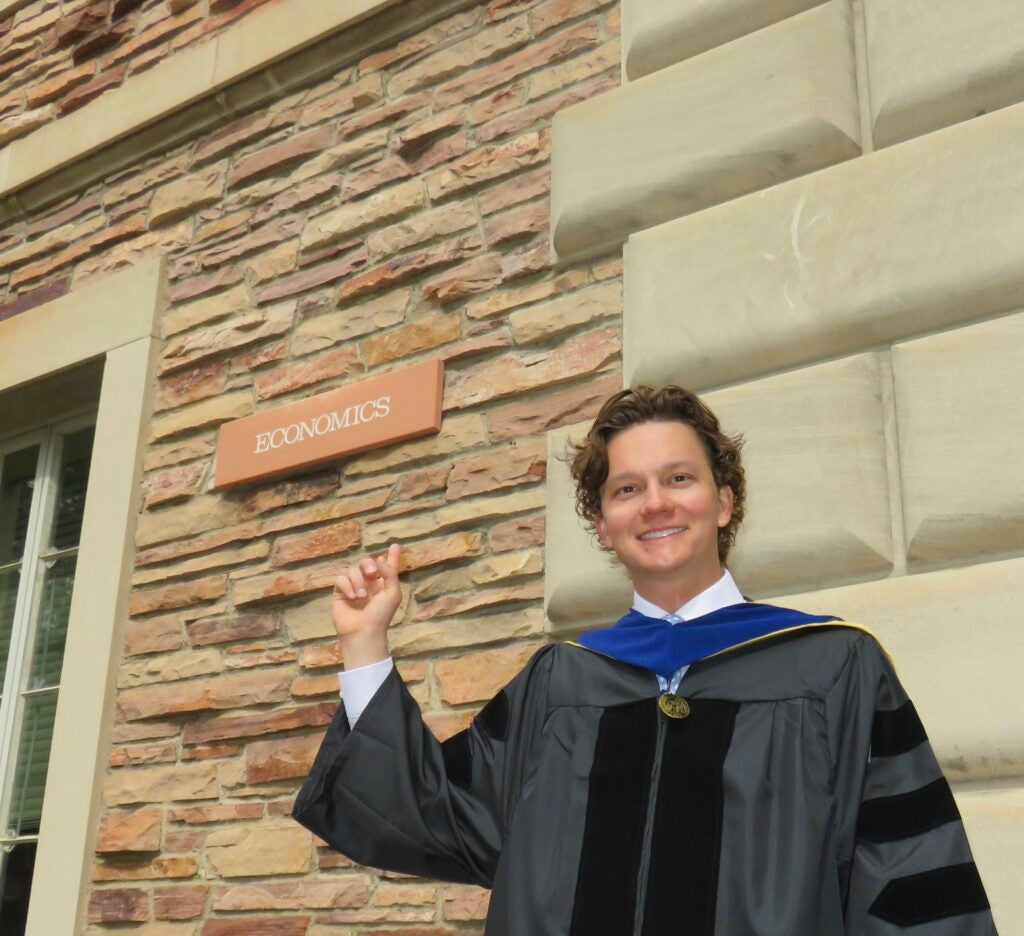
Michael Karas is a recent Ph.D. graduate in economics from the University of Colorado Boulder. His research lies at the intersection of industrial organization, environmental and energy economics, and economic history, with a particular interest in how regulation and market structure shape the behavior of incumbent firms and the persistence of incumbent technologies.
Karas’ dissertation, “Regulating Natural Monopolies: Evidence from the Early American Utility Industry,” examines the roles of regulation and incumbent firms in the adoption of new technologies in the U.S. gas and electricity industries during the first half of the 20th century. Drawing on newly digitized historical data, his dissertation studies the emergence of state utility regulation and how regulatory institutions shaped incumbent firms’ decisions during major technological transitions, including the shift from manufactured to natural gas.
His current research includes projects on household demand for gas and electricity services in the early 20th century, the adoption and diffusion of block-rate pricing among early American utilities, and the efficiency of secondary markets for wireless spectrum.
Originally from Nashville, Tennessee, Karas received his B.A. in economics and history from Vanderbilt University and his M.A. in applied economics from the University of Illinois Chicago before earning his Ph.D. in economics from the University of Colorado Boulder. Outside of research, he is an avid cyclist who competes in amateur road and track races and enjoys playing the banjo.
Matt Murtagh-White, Postdoctoral Research Fellow

Matt Murtagh-White recently completed his Ph.D. in computer science at Trinity College Dublin, where his research focused on using natural language processing and machine learning to extract structured, policy-relevant evidence from research papers and evaluation documents. He also holds an M.S. in economics for development from the University of Oxford and has worked across data science, economics, and public policy, including as an ODI Fellow at the National Institute of Statistics of Rwanda and as a researcher for Ireland’s AI Advisory Council.
Murtagh-White’s current research interests sit at the intersection of AI, firm behavior, economic measurement, and technology policy. Recently, he has worked with researchers at Georgetown University and the World Bank on projects studying AI diffusion and digital technology adoption by firms across developed and emerging economies.
Outside of research, Murtagh-White enjoys hiking, cold water swimming, and experimenting with video game design. His most memorable hike was up Mount Nyiragongo, an active volcano in the Democratic Republic of the Congo.